
The two-time Olympian talks to Olympics.com about the similarities between his studies and his sport ahead of the 2025 IFSC Climbing World Championships in Seoul.
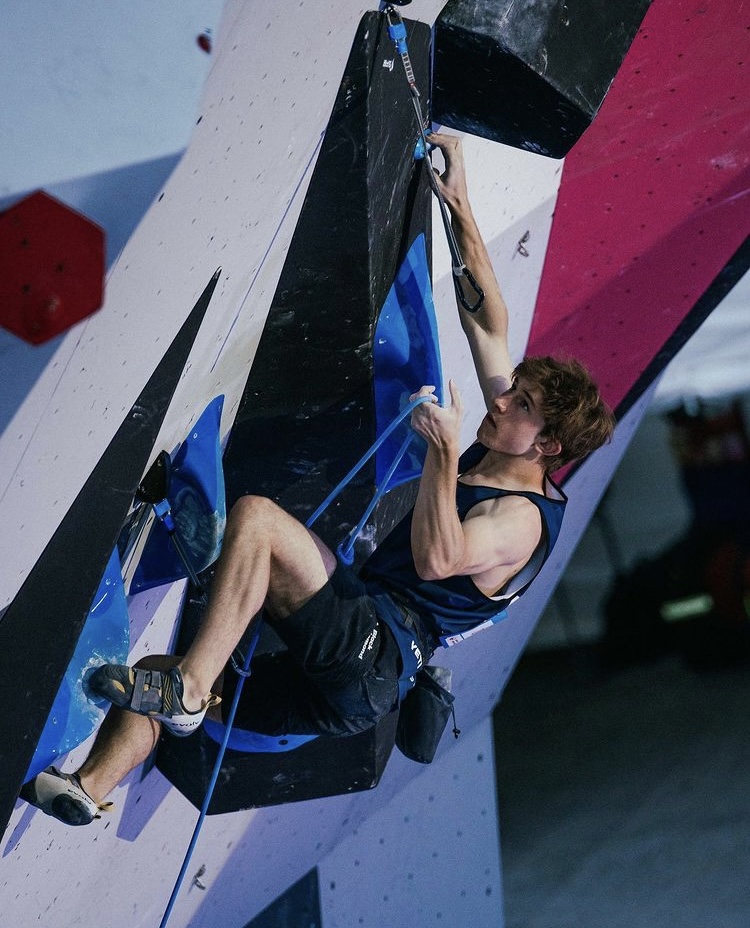
When it comes to problem-solving, Colin Duffy could be sitting in a classroom or hanging from a wall.
The US athlete, after all, leads a double life. He studies Applied Mathematics at the University of Colorado and is also a two-time Olympian in sport climbing.
“I think applied math and sport climbing are similar in the problem-solving aspect,” he tells Olympics.com.
“The whole time you have to find a way to the solution, but there are many different paths you can take.
“There are many different approaches, but it’s very analytical, and it’s a good challenge, and that’s why I enjoy both.”
Duffy is set to compete at the 2025 IFSC Climbing World Championships in Seoul this month, proving he can compete with the very best while still studying.
“I’ve realised over time that having this balance between the two keeps climbing fresh for me and it keeps school fresh for me, and so I’m not always focused on one thing,” he adds.
“It allows me to keep happy and stay balanced throughout the year.”
Colin Duffy: ‘Sport climbing is like a puzzle’
Sport climbing is not for the faint of heart, and when faced with a daunting lead or boulder problem, athletes must carefully plot their routes.
It is clear then to see why Duffy thrives off the challenge, with the 21-year-old claiming three World Cup golds so far in his career – two in lead and another in boulder.
“Sport climbing is like a puzzle because you have a given start and finish point, but you have no information on how to get there,” he says.
“And so as an athlete, my main objective when I’m competing is to figure out what my solution is going to be to get to the top.
“As a climber, my goal is to figure out the solution that works best for me, and often you’ll see athletes using different sequences or different paths up to the top of the wall, and it’s interesting how everyone’s brain and body works a little bit differently.”
Duffy has therefore learned how his own brain works and how his decision-making plays out high up on a lead wall, where the top is a minimum of 15 metres in height.
“I think the most difficult mental aspect to master is making quick and good decisions under pressure, because sometimes when we’re high up on the lead wall your brain is running at 100 miles per hour,” he adds.
“Being able to slow that down… It takes a lot of time to learn how to make these tough decisions, and I think that’s something that I’m quite good at in competitions, and hopefully I can get closer to mastering that skill within myself.”
Colin Duffy’s LA28 mission – two events?
Duffy was the youngest climber to compete at Tokyo 2020 at the age of 17, where he finished seventh overall.
He then came within a hold of the podium at Paris 2024, placing fourth as Toby Roberts beat Sorato Anraku to gold and Jakob Schubert took home the bronze – narrowly ahead of Duffy.
“Getting fourth in Paris was definitely bittersweet,” says Duffy. “It was tough, I was like one hold off of the podium, but at the same time I was very happy to make it to the finals again and place fourth.”
Duffy therefore has added motivation to not only feature at his home Olympic Games in 2028 but to also win a medal in Los Angeles.
Although he is not looking that far ahead just yet.
“For LA, I’m just taking it one step at a time,” he adds. “My goal is to qualify for LA, but right now I’m focused on the World Cups and the world championships – that’s the only thing on my mind right now. So as it gets closer to LA I’ll worry about that.”
Sport climbing at LA 2028 will be separated into three disciplines, a change from Paris 2024, which had combined boulder and lead into one event.
And Duffy is a fan of the new Olympic format, which could see him climb for gold on two fronts.
“I think it’s really cool in LA that speed, bouldering, and lead are all separate. People can choose which one fits them the best and really try to push their limit within that specific discipline,” he says.
“The last two Olympics, athletes have had to balance something that maybe is weaker for them, that they don’t actually want to train as much, but for me I am going to try and compete in both bouldering and lead as I enjoy doing both of them.
“I can’t see myself choosing one discipline, but for others I think the level of the sport is increasing a lot over the last few years as people start to specialize and take one discipline as far as they can.”
 Sports Marketing and Entertainment Management